Paper
Computer Vision – ECCV 2026
Published

European Conference on Computer Vision (ECCV) 2026
A whole conversation.
From one line of text.
Conversational Human Audio-visual Talking Dialogue Generation
Code, weights and the evaluation protocol are on GitHub.
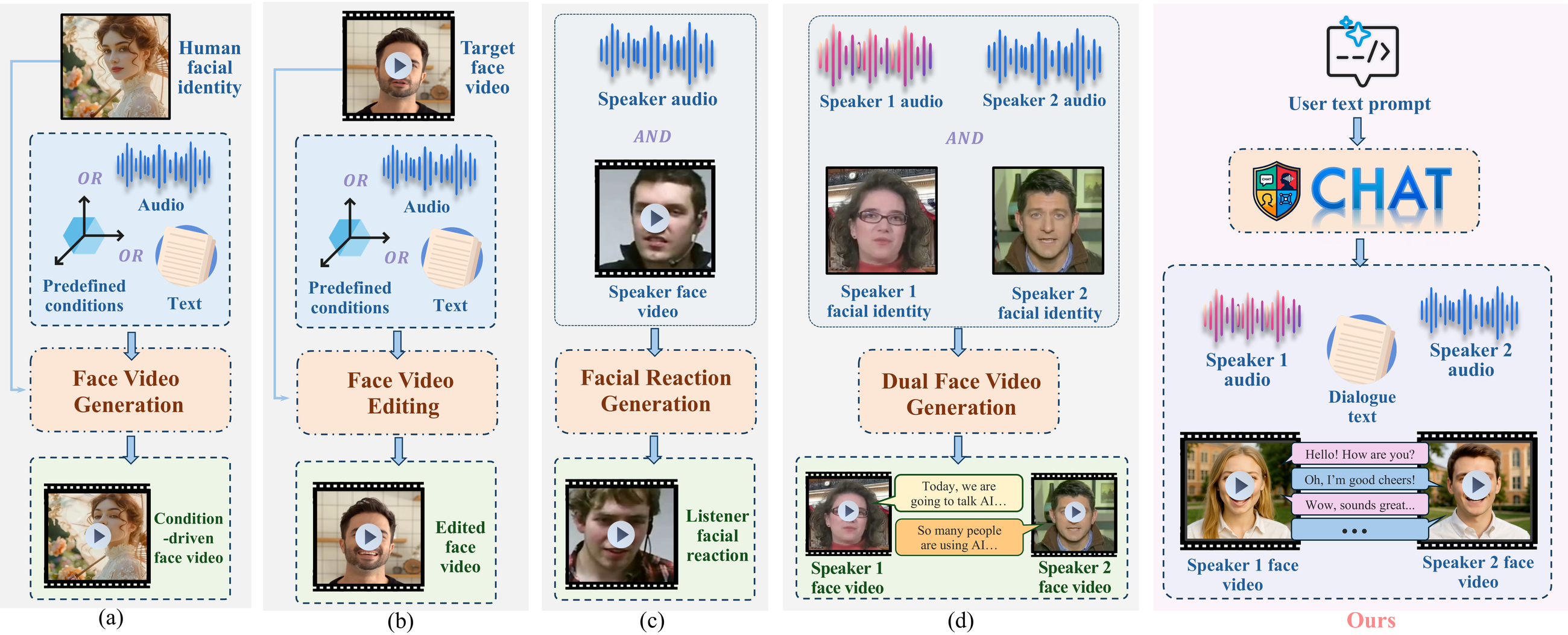
Other methods animate one face from a condition, edit a clip you already have, or react to a partner you supply. CHAT writes the conversation, speaks it, and performs both sides.
Video
The task, the three stages, the results and the dataset, in one narrated film.
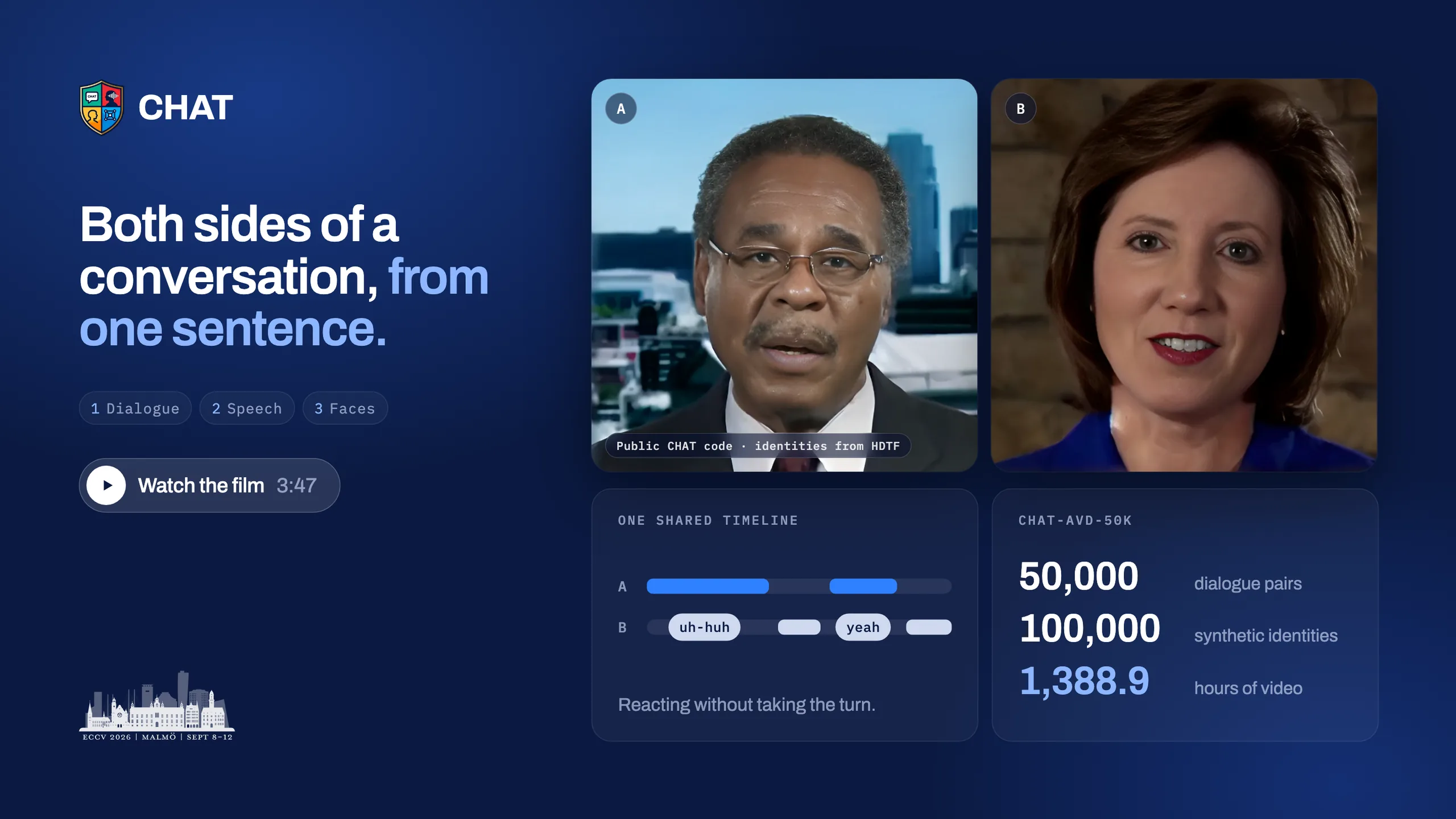
Narrated with a synthetic voice; the cover faces come from the public CHAT code with HDTF identities. Nothing loads from YouTube until you press play. Open on YouTube ›
Generated dialogues
Nine prompts, nine conversations, eighteen identities that were never paired by hand. Both faces in a clip are generated as a responsive pair, so the one listening reacts to the one speaking, inside the same clip.
No unit list was kept for this clip, so there is no timeline to draw.
Five turns in ten seconds. Each speaker talks twice and drops a back-channel into the other’s turn, all on one shared timeline.
Both sides interrupt politely: an "uh-huh" at two seconds, a "yeah" at eight, each landing inside the other speaker’s sentence.
A disagreement about which database to use. The reply cuts in as soon as the first speaker stops, with a back-channel halfway through.
An interview about a startup. The listener’s back-channel lands at 3.7 seconds, and the follow-up question waits for the answer to finish.
A grandparent and a grandchild. Four spans here, and the last back-channel starts in the final half second of the clip.
Talking someone down before they go on. Reassurance and doubt each get a sentence, and each takes a back-channel inside it.
A neighbour raises the mess left after a party. The apology begins two tenths of a second after the complaint ends.
Two organisers before the gates open. The reply runs five and a half seconds and takes a "yeah" at 8.2.
Identities need not be photorealistic. The same method drives illustrated faces with no change. This clip comes from the conference video, so it is lower resolution than the others.
Each clip is the full CHAT output for one prompt, generated at 512 px per face and then passed through the CodeFormer face upscaler that Hallo2 ships, which doubles it to 1024 px a side. Every number on this page is measured before that step. The eight real-identity clips play without sound on this page; the illustrated clip keeps the soundtrack from the conference video. Each timeline is drawn from that clip's own generated unit list, except the illustrated one, whose list was not kept and whose turns are measured back from the clip by pitch. Identity descriptors carry no gender, so a face and a voice are drawn independently and need not agree.
How it works
A language model turns one scenario prompt into multi-turn dyadic scripts, each with a described identity for both speakers.
Back-channels, per-turn emotion, timing and a shared acoustic environment are added, then synthesised as two voices on one timeline.
Talking segments are rendered, listening segments generated, each face made responsive to its partner, and every seam blended away.
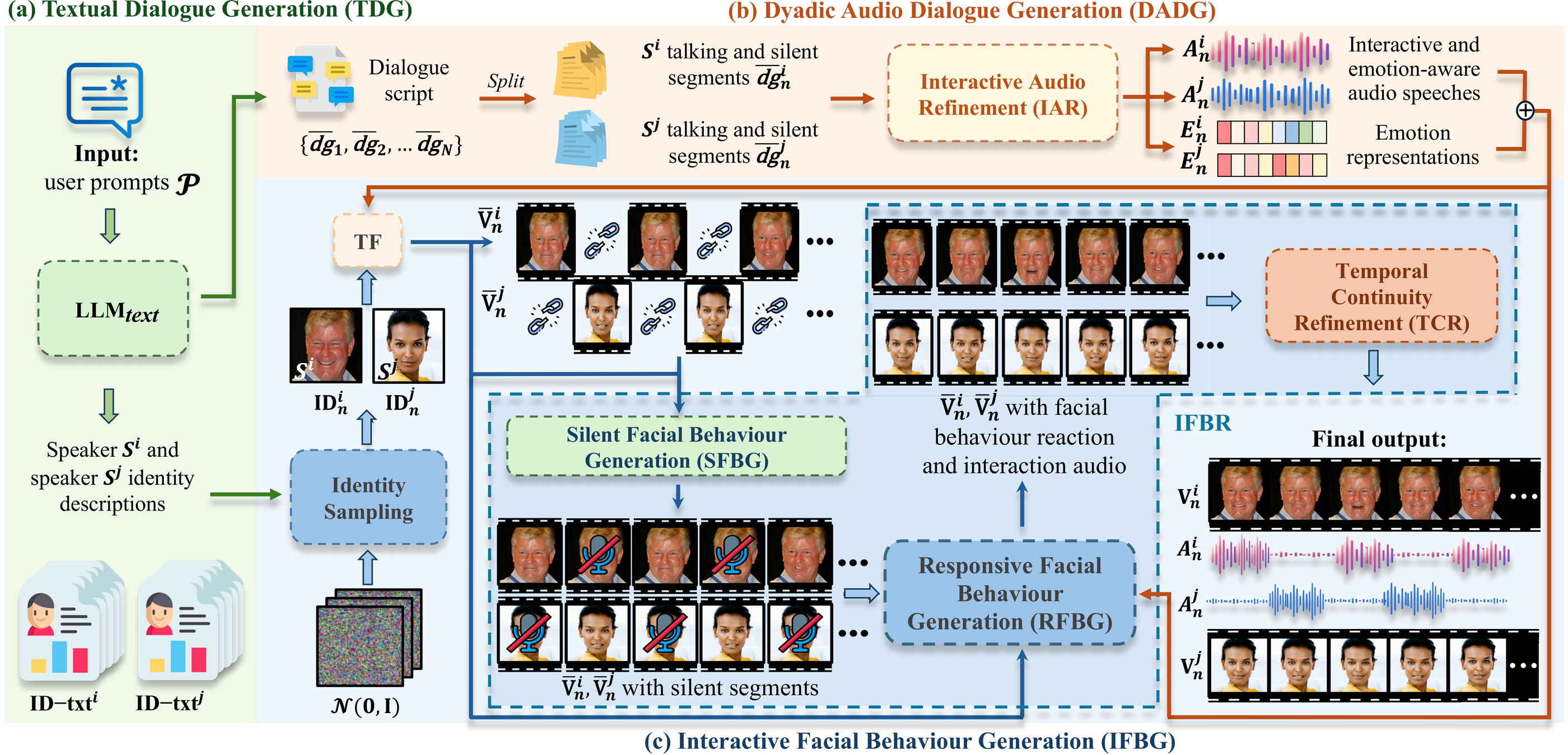
The full pipeline. TDG writes the dialogue pairs and identity descriptors, DADG turns each dialogue into interactive emotion-aware audio, and IFBG synthesises the responsive face-video pair.
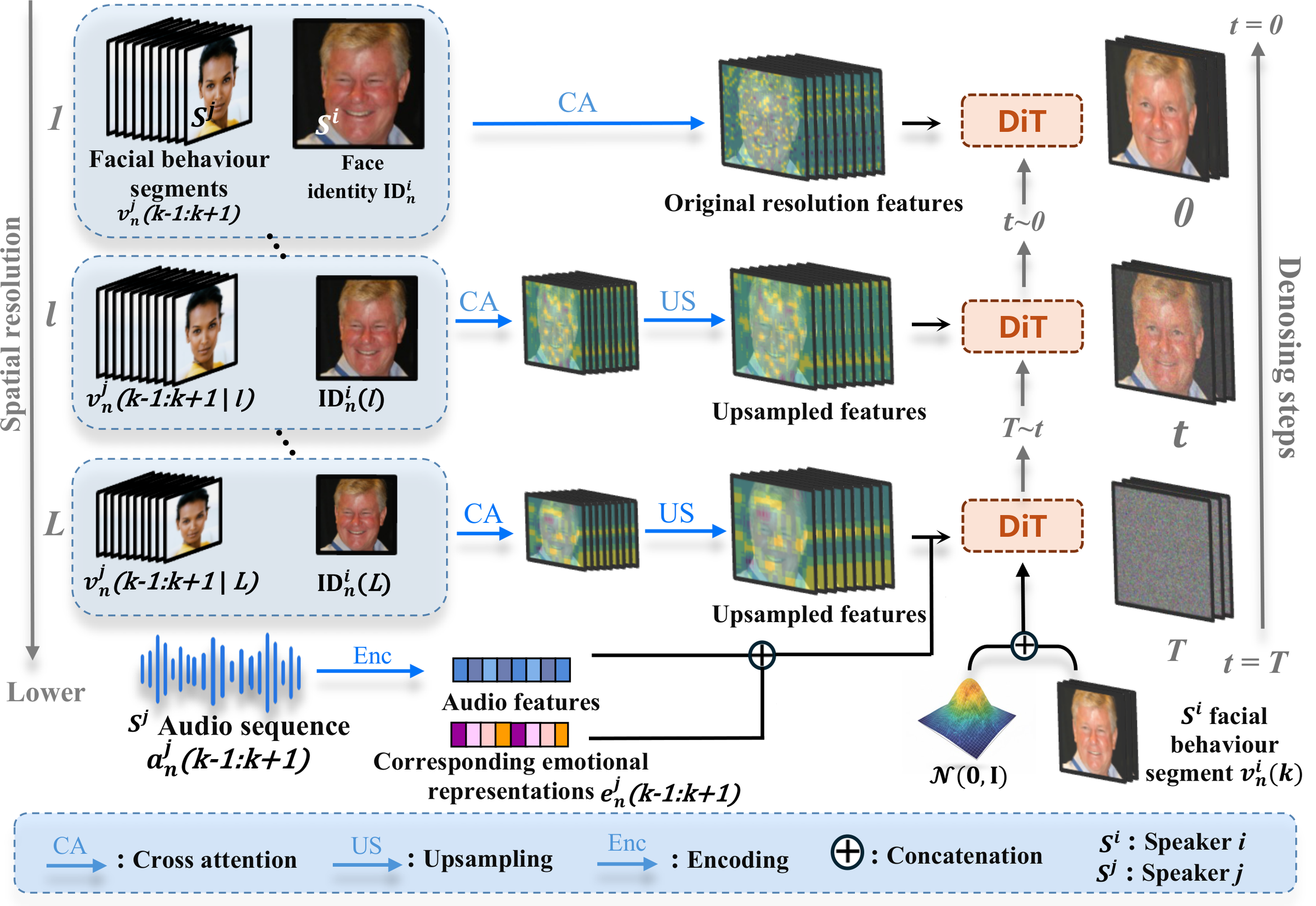
Inside the responsive block. Identity and the partner's behaviour are fused at several spatial scales, then fed into the diffusion transformer coarse first and fine last, so early steps settle the shape of a movement and later steps bring in the detail.
Inside
Each diagram below is the actual rule the paper specifies, animated as you scroll rather than described in prose.
01
Sentences and back-channels are laid on a single shared timeline. While one speaker holds the turn the other is silent, apart from the short interactive words that keep the exchange alive.
Winter = { uh-huh, hmm, okay, yeah }
02
The partner's behaviour is fused with the identity at several spatial scales. Early denoising steps receive only the coarsest scale, which fixes the shape of a movement. Finer scales join as the steps go on, bringing in detail.
l(t) = max(1, ⌈L·t / T⌉) · Φ(t) = ⋃l=l(t)L C(l)
03
Segments are refined separately, so their join could show. A half-Gaussian cross-fade over a narrow window blends the two sides, weighted equally at the boundary itself and decaying outwards.
α(τ) = ½ exp( −(τ−1)² / 2σ² ), σ = W/3
Overview
Large-scale dyadic interactive audio-visual dialogue datasets are the raw material for interactive virtual agents and digital humans. Collecting them is slow, expensive, and ethically sensitive.
CHAT generates them instead. It unifies large language models and talking-face models with interactive audio and facial-behaviour refinement, producing aligned dyadic clips with diverse content and diverse identities from a single prompt. It outperforms existing methods built for related tasks under both objective and subjective evaluation.
The synthesised CHAT-AVD-50k dataset then works as pre-training data for downstream interactive head generation, improving both PerFRDiff and ReactDiff on REACT 2024.
Benchmarks
No existing method addresses this task directly, so CHAT is compared with recent methods for the nearest related tasks, all given the same prompts and audio and standardised on the first ten seconds. Means over 1000 generated dialogues.
| Method | FID↓ | FVD↓ | LSE-C↑ | LSE-D↓ | FRCorr↑ | FRDiv↑ | CSIM↑ | LPIPS↓ |
|---|---|---|---|---|---|---|---|---|
| Hallo3 | 20.56 | 362.23 | 4.61 | 10.41 | N/A | N/A | 0.79 | 0.55 |
| SadTalker | 22.53 | 385.51 | 6.85 | 8.17 | N/A | N/A | 0.81 | 0.48 |
| DIM | 36.52 | 460.35 | 6.82 | 8.89 | 31.02 | 12.55 | 0.83 | 0.52 |
| EDTalk | 18.74 | 619.92 | 5.62 | 9.61 | N/A | N/A | 0.78 | 0.36 |
| ReactDiff | 21.36 | 386.22 | 5.23 | 9.02 | 48.05 | 15.31 | 0.77 | 0.58 |
| CHAT | 17.33 | 365.03 | 6.89 | 8.07 | 50.02 | 15.34 | 0.85 | 0.38 |
Best in bold, second underlined. FRCorr and FRDiv are ×10⁻². N/A marks a metric a method cannot produce.
| Method | Visual | Audio | Sync | Expr. | Interact. |
|---|---|---|---|---|---|
| Hallo3 | 4.5 | 3.5 | 3.9 | 3.8 | 2.5 |
| SadTalker | 2.5 | 3.7 | 1.2 | 2.0 | 1.3 |
| DIM | 3.7 | 3.1 | 3.4 | 2.8 | 3.6 |
| EDTalk | 2.2 | 3.6 | 2.3 | 2.8 | 2.7 |
| ReactDiff | 4.2 | 3.5 | 3.8 | 4.1 | 3.2 |
| CHAT | 4.6 | 4.8 | 4.6 | 4.6 | 4.8 |
| Variant | MCD↓ | Emo-Acc↑ | ViSQOL↑ | FID↓ |
|---|---|---|---|---|
| w/o audio refinement | 6.23 | 41.2% | 2.97 | 21.34 |
| w/o emotion | 9.12 | 38.3% | 2.67 | 23.45 |
| w/o facial refinement | — | — | — | 38.67 |
| w/o boundary continuity | — | — | — | 18.56 |
| Full CHAT | 4.23 | 78.4% | 3.98 | 17.33 |
A dash marks an audio metric a visual-only ablation leaves unchanged.
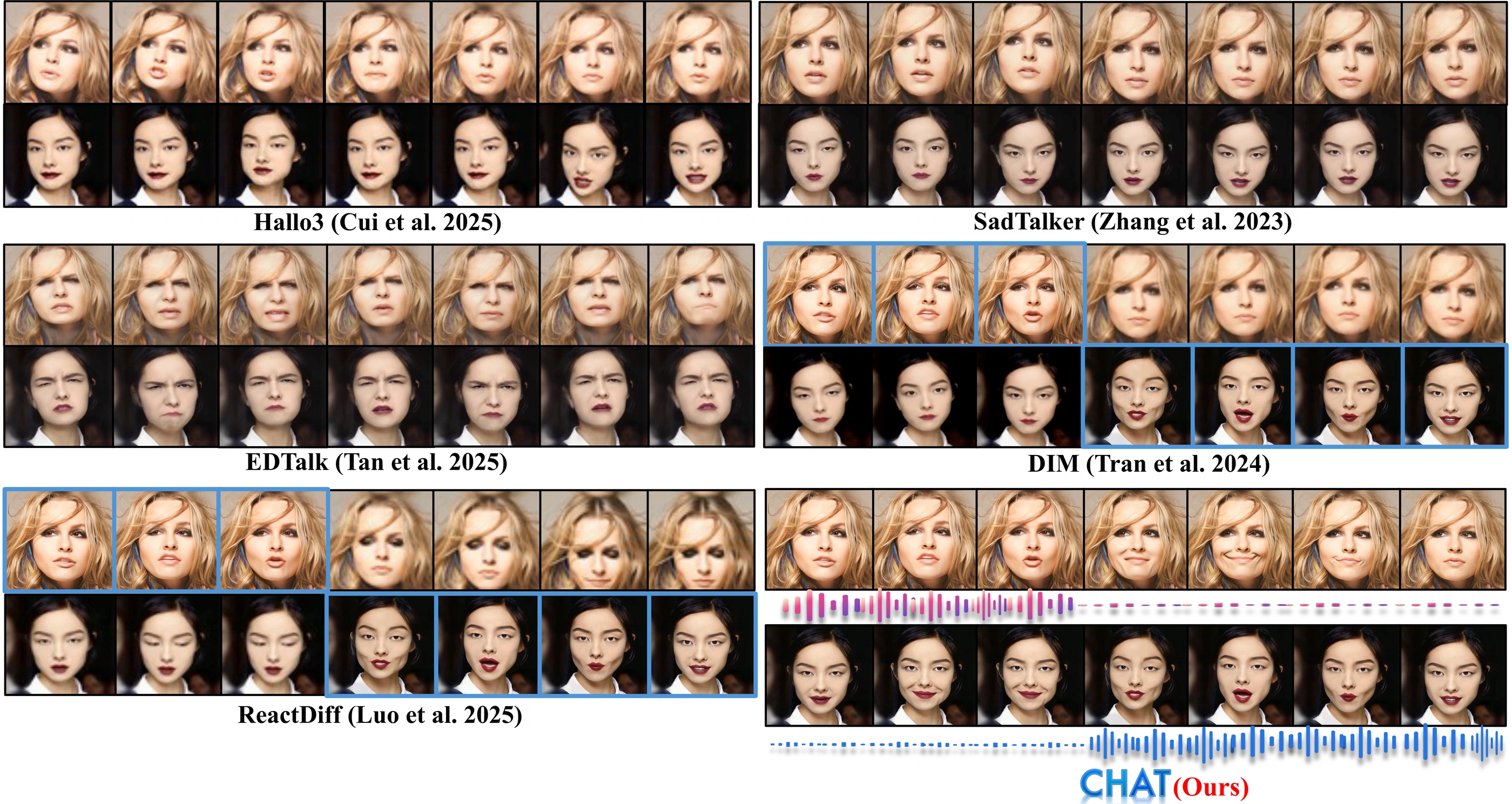
Talking-face methods run twice give two unrelated monologues. Reaction methods need a real speaker video as input. CHAT produces the pair as one exchange.
CHAT-AVD-50k
Every clip carries turn-level emotion, scenario and speaker metadata, spanning casual, professional, emotional, academic and social scenarios. As pre-training data it lifts two different reaction models on the REACT 2024 benchmark.
| Pre-training | PerFRDiff FRCorr↑ | FRDist↓ | ReactDiff FRCorr↑ | FRDist↓ |
|---|---|---|---|---|
| REACT 2024 only | 37.21 | 94.72 | 24.19 | 86.70 |
| + CHAT-AVD-50k | 40.11 | 89.45 | 26.12 | 83.87 |
Poster
Thursday 10 September 2026, 7:30–9:30 PDT, ExHall #163. Conference page ›
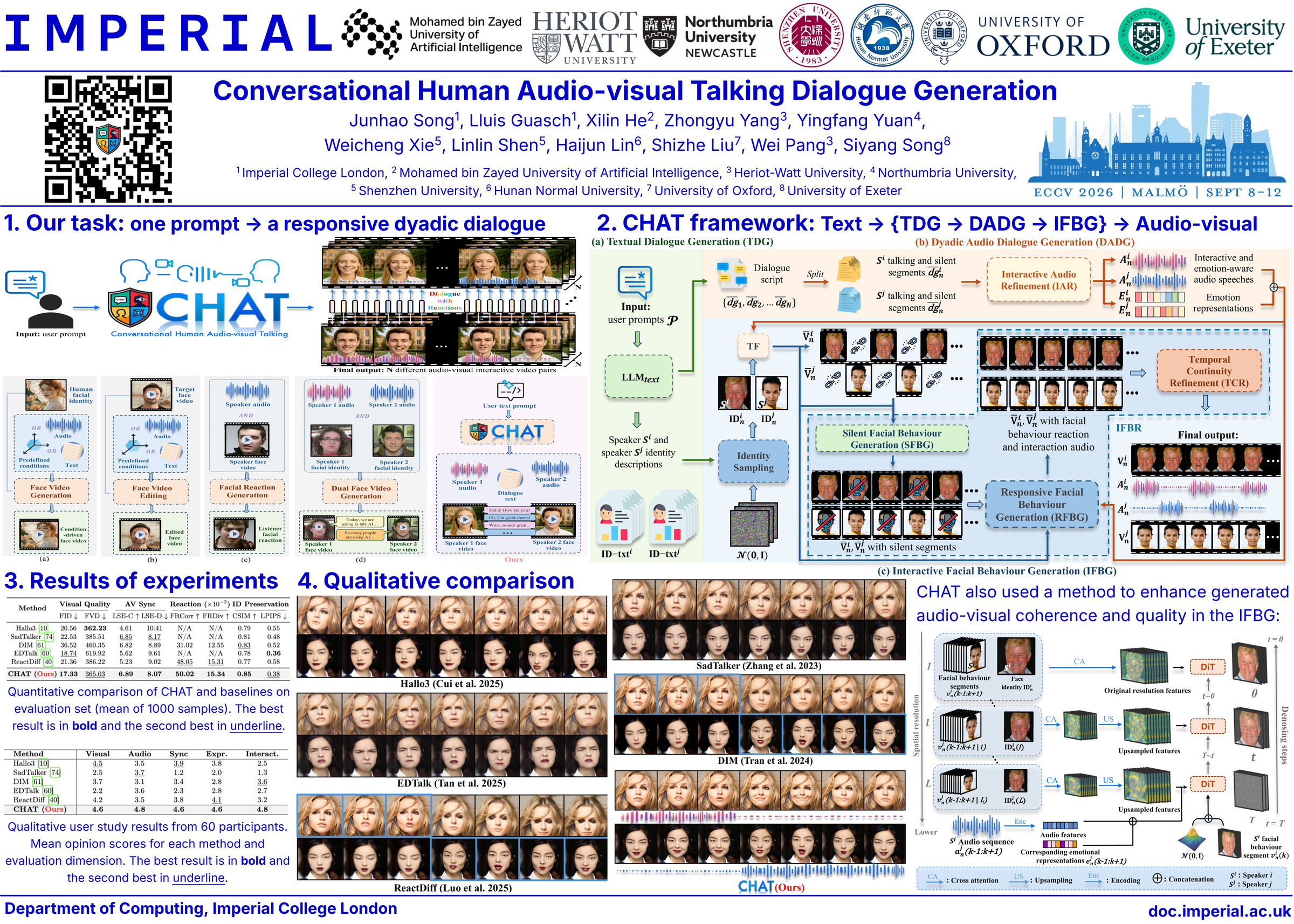
Open the poster to read it, or take the printed PDF, 1400 by 1000 mm.
The team
1Imperial College London 2Mohamed bin Zayed University of Artificial Intelligence 3Heriot-Watt University 4Northumbria University 5Shenzhen University 6Hunan Normal University 7University of Oxford 8University of Exeter †Corresponding author
@inproceedings{song2026chat,
  title     = {Conversational Human Audio-visual Talking Dialogue Generation},
  author    = {Song, Junhao and Guasch, Lluis and He, Xilin and Yang, Zhongyu and
               Yuan, Yingfang and Xie, Weicheng and Shen, Linlin and Lin, Haijun and
               Liu, Shizhe and Pang, Wei and Song, Siyang},
  booktitle = {Computer Vision -- ECCV 2026},
  year      = {2026},
  publisher = {Springer Nature Switzerland},
  address   = {Cham},
  pages     = {597--616},
  doi       = {10.1007/978-3-032-37252-9_33}
}